eBay vs Amazon: The Complete Seller's Guide (2026)
Compare eBay vs Amazon on fees, traffic, fulfillment, and earnings. Find out which platform is better for sellers in 2026 based on real data.
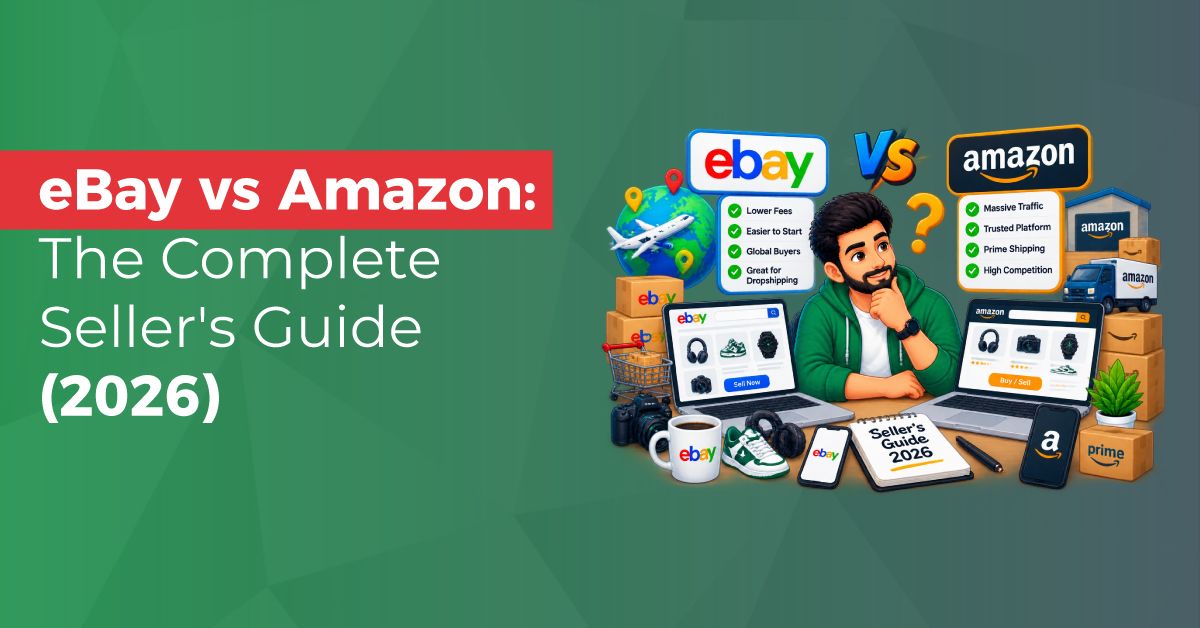
eBay vs Amazon:
The Complete Seller's Guide (2026)
Fees, traffic, fulfillment, competition, and earnings — every dimension compared so you can make the right choice for your business in 2026.
Two platforms. Two very different philosophies. Both have created millionaires — and both have left sellers frustrated, confused, and second-guessing every decision. If you're trying to figure out whether to sell on eBay vs Amazon in 2026, this guide cuts through the noise and gives you the honest, side-by-side comparison every seller needs before they invest a single dollar.
Whether you're a complete beginner or a seasoned seller evaluating where to focus next, by the end of this guide you'll know exactly which platform — or which combination — makes sense for your business, your products, and your goals.
What Is the Difference Between eBay and Amazon?
To understand selling on eBay vs Amazon, you first need to understand what each platform fundamentally is — because they are very different beasts built on different foundations.
The Peer-to-Peer Marketplace
- Founded in 1995 by Pierre Omidyar as AuctionWeb
- Pure marketplace — eBay sells nothing itself
- Connects individual sellers directly to buyers
- Famous for auctions, used items, collectibles
- Payments managed via eBay Managed Payments
- Research tools: Terapeak, eRank
The Retail Giant with a Marketplace
- Founded in 1994 by Jeff Bezos as a bookstore
- Both a retailer AND a marketplace for third parties
- Amazon competes directly with its own sellers
- Famous for Prime, new products, speed
- Payments via Amazon Pay, Seller Central
- Research tools: Helium 10, Jungle Scout
The core philosophical difference: on eBay, you are the brand. On Amazon, Amazon is the brand — and you're a supplier in its ecosystem. That difference shapes every other comparison in this guide.
For a quick take on why many Pakistani entrepreneurs start with eBay first, see our related article: Why eBay Is Easier Than Amazon for Pakistani Sellers.
eBay vs Amazon: Key Stats and Numbers in 2026
Numbers tell part of the story. Here's where both platforms stand in 2026 — and what the data means for sellers.
Amazon wins on raw traffic and customer volume. But eBay's 17 million active sellers compared to Amazon's 2 million tells its own story — eBay's barrier to entry is dramatically lower, making it the more accessible marketplace for most independent sellers.
How Each Platform Makes Money (Business Model)
Understanding how each platform profits directly impacts how they treat their sellers — and how much of your revenue they keep.
Pure Commission Business
- Takes a % of every sale through Final Value Fees
- Charges for optional listing upgrades
- Sells optional Store subscriptions
- Earns from eBay Managed Payments processing
- Does NOT compete with its own sellers
- Seller success = eBay success (aligned interests)
Multi-Revenue Giant
- Sells its own products (competing with you)
- Takes referral fees from every third-party sale
- Charges monthly seller fees ($39.99/month)
- Profits from FBA storage and fulfillment fees
- Prime subscriptions, AWS cloud services
- Seller success is secondary to Amazon's own sales
eBay's business model is better aligned with seller success. Since eBay sells nothing itself, every seller's profit is in eBay's interest. Amazon's model creates an inherent conflict — Amazon regularly uses third-party sales data to launch competing private-label products.
eBay vs Amazon Fees Compared
The Amazon vs eBay fees comparison is critical before you price a single product. Sellers who don't map every cost category before listing almost always end up working for less than minimum wage — or at a loss.
| Fee Category | 🛒 eBay | 📦 Amazon |
|---|---|---|
| Monthly Subscription | Free (Store optional from $4.95) | $39.99/mo (Professional) or $0.99/item |
| Listing (Insertion) Fee | Free first 250/month; $0.35 after | Included in monthly fee |
| Final Value / Referral Fee | 13.25%–15% (most categories) | 8%–15%+ (varies widely by category) |
| Per-Order Processing | $0.30–$0.40 per order (eBay Managed Payments) | Included in referral fee |
| Fulfillment Fee | None (seller handles shipping) | FBA: $3.22–$15.87+ per unit by size/weight |
| Storage Fee | None | $0.78–$2.40/cubic foot/month (higher Oct–Dec) |
| Payout Method | Payoneer, bank transfer, PayPal | Direct bank deposit only |
| Advertising | Promoted Listings: 2–15% of sale | PPC ads: highly competitive, $0.30–$5.00+ CPC |
eBay's fee structure is simpler, more transparent, and significantly cheaper for new sellers. No monthly fee, no storage costs, and no FBA complexity. For sellers starting out, eBay's cost structure is far more forgiving — and Payoneer support makes it accessible globally, including for Pakistani sellers.
Traffic and Customer Base
Traffic determines how many potential buyers ever see your listings — and on this metric, the two platforms are not even close.
Amazon receives over 9.7 billion monthly visits and has become the default product search engine for most US shoppers — many buyers go straight to Amazon without even touching Google. The platform's Amazon Prime membership program (200M+ members globally) means a significant portion of buyers are pre-committed to purchasing on Amazon and expect free two-day shipping as standard.
eBay draws an estimated 1.1–1.5 billion visits per month — respectable, but a fraction of Amazon's reach. However, eBay's buyers shop with fundamentally different intent. They're often looking for used items, rare finds, collectibles, vintage goods, or products they can't find on Amazon. This creates lower volume but higher buyer intent in those specific categories.
Amazon dominates on raw traffic and buyer volume. If you're selling new, mass-market products, Amazon's organic reach gives you access to buyers who are ready to buy immediately. eBay is the winner for niche, unique, or second-hand products where its dedicated buyer base has no Amazon equivalent.
Fulfillment Options for Sellers
Self-Managed (No FBA Equivalent)
- Sellers handle all packing and shipping personally
- eBay Standard Envelope for small/light items ($0.73 flat rate)
- eBay International Shipping for cross-border sales
- Full control over packaging and brand experience
- No storage fees or minimum inventory requirements
- Flexibility to ship from any location, including Pakistan
FBA, FBM, or AMZL
- FBA (Fulfillment by Amazon) — store inventory in Amazon warehouses, Amazon ships for you
- FBM (Fulfilled by Merchant) — you handle shipping, no Prime badge
- AMZL (Amazon Logistics) handles last-mile for FBA orders
- FBA gives the coveted Prime badge (massive conversion boost)
- Requires upfront inventory investment and inbound shipping costs
- Complex prep requirements; long-term storage penalties
FBA is a genuine superpower for scalable businesses with capital and a proven product — the Prime badge meaningfully improves conversion rates. For beginners, solo sellers, and those shipping from Pakistan or other international locations, eBay's flexible self-managed shipping (with eBay International Shipping support) is far more accessible and has far lower upfront cost.
Seller Competition and Ranking
Cassini Algorithm
- eBay's search engine is called Cassini
- Ranks on: title keywords, seller history, price, sell-through rate
- Individual listings compete — not always brand vs brand
- New sellers can rank quickly with great listings
- Research with Terapeak (free in Seller Hub)
- No "Buy Box" equivalent — all listings can be visible
A9 / A10 Algorithm
- Amazon uses the A9/A10 algorithm for product ranking
- The Buy Box — only ONE seller wins it at a time
- Price, fulfillment method, seller metrics determine Buy Box winner
- FBA sellers have massive Buy Box advantage over FBM
- Heavily influenced by advertising spend and sales velocity
- Research with Helium 10, Jungle Scout
eBay's Cassini algorithm gives new sellers a legitimate path to visibility without a large ad budget. Amazon's Buy Box system means that without FBA or deep pockets for PPC campaigns, new FBM sellers are nearly invisible. For beginners, eBay's competitive landscape is significantly more level.
Branding and Seller Control
Seller Identity Matters
- Seller username and feedback are prominently displayed
- eBay Stores allow custom branding, logos, banners
- eBay Seller Hub gives full business analytics
- Buyers often choose based on seller reputation
- No equivalent of Brand Registry — but also no competing Amazon brand
- Direct buyer-seller relationship is central to the platform
Amazon's Brand First, Yours Second
- Brand Registry unlocks A+ Content, storefronts, brand analytics
- A+ Content significantly improves conversion rates
- Seller Central provides detailed performance data
- But "Sold by [Your Brand] Fulfilled by Amazon" — Amazon brand wins
- Amazon can clone your best sellers with their private label
- Buyers trust Amazon, not you — you're interchangeable
eBay sellers build genuine brand equity and customer loyalty within the platform. On Amazon, buyers trust the platform, not the seller — Amazon Brand Registry and A+ Content are powerful tools, but Amazon's own interests always come first. Long-term brand building is meaningfully more achievable on eBay.
Customer Service and Dispute Resolution
eBay Money Back Guarantee
- eBay Money Back Guarantee covers most buyer claims
- Disputes handled through Resolution Center
- eBay Managed Payments processes chargebacks
- Sellers have more ability to challenge false claims
- Feedback system gives sellers recourse too
- Generally more balanced — buyer-friendly but seller-aware
A-to-Z Guarantee (Heavily Buyer-Sided)
- Amazon's A-to-Z Guarantee strongly favors buyers
- Sellers often bear refund costs even when not at fault
- High return rates are common and costly for FBA sellers
- Amazon support can be difficult to navigate for sellers
- Account suspensions happen suddenly, often without clear recourse
- Seller Central feedback system less visible to buyers
While neither platform is perfectly seller-friendly, eBay's dispute resolution is more balanced. Amazon's A-to-Z Guarantee is legendary for allowing buyers to return products after use with full refunds, leaving sellers absorbing the cost with limited appeal options.
What Products Sell Better on Each Platform
This is where the real decision often gets made. Your product type should heavily influence which platform you choose — because the buyer intent on each platform is fundamentally different.
🛒 Sells Best on eBay
- Used, pre-owned, and refurbished items
- Vintage and antique goods
- Collectibles (coins, stamps, cards, memorabilia)
- Rare, hard-to-find, or discontinued products
- Handmade and artisan items
- Sports goods (Pakistan's manufacturing edge)
- Automotive parts and accessories
- Musical instruments and equipment
- Pakistani cultural textiles and handicrafts
📦 Sells Best on Amazon
- New, branded mass-market products
- Electronics and tech accessories
- Consumables (health, beauty, grocery)
- Books, media, entertainment
- Home and kitchen products
- Baby and children's products
- Fitness and sports equipment (new)
- Private label products at scale
- Subscription-type replenishment items
If someone would search for it on Google and expect to find it new, it likely sells better on Amazon. If someone would dig through a flea market, estate sale, or niche enthusiast forum to find it, it sells better on eBay. When in doubt — check Sold Listings on eBay (via Terapeak) and Amazon BSR data (via Helium 10) for the same product before committing to either platform.
Which Platform Is Better for Beginners?
If you're new to eBay vs Amazon for sellers, this section may be the most important one for your decision right now.
Lower Barrier, Faster Start
- Zero monthly subscription to start selling
- List your first item in under 10 minutes
- Start with items you already own at home
- No inventory investment required to begin
- Payoneer support for international sellers
- Gradual learning curve with Seller Hub
- eBay seller community is highly supportive
Higher Potential, Steeper Learning Curve
- $39.99/month from day one (Professional plan)
- More complex setup — Seller Central, product approval
- Gated categories require application and approval
- FBA requires significant upfront capital
- Higher competition in most niches
- PPC advertising almost necessary to compete
- International sellers face additional verification steps
For beginners — especially those starting with limited capital or selling from outside the US — eBay is the significantly better starting point. Zero monthly fees, no inventory requirements, Payoneer payment support, and a much more forgiving learning environment make eBay the right first platform for the vast majority of new sellers.
Can You Sell on Both eBay and Amazon?
Yes — and for many established sellers, multichannel selling is the smartest long-term strategy. Each platform reaches buyers the other doesn't, and diversifying across both eliminates the single-platform dependency risk that has bankrupted sellers when accounts were suspended without warning.
Use eBay for used items, vintage pieces, niche products, and anything unique. Use Amazon for new, scalable products with FBA once you've validated demand. Cross-list where appropriate, but maintain separate inventory strategies for each platform's buyer expectations. Tools like Linnworks, Sellbrite, and SkuVault can help manage inventory across both simultaneously.
The key risk to avoid: promising the same item in the same quantity on both platforms simultaneously without a live inventory sync system. Overselling on one platform after the item sells on the other generates defects on both accounts rapidly.
Final Verdict: eBay or Amazon for Sellers in 2026?
There is no single correct answer — only the right answer for your specific situation. Here's the honest breakdown:
🛒 Choose eBay If…
- You're just starting and want zero upfront costs
- You sell used, unique, vintage, or handmade items
- You're based in Pakistan or another international location
- You need Payoneer as your payment method
- You want to control your brand identity and customer relationship
- You prefer simpler fees without hidden storage costs
- You sell one-of-a-kind or low-volume items
- You want to start selling within hours, not weeks
📦 Choose Amazon If…
- You have capital to invest in inventory and FBA
- You sell new, mass-market, brandable products
- You want access to 310M+ active customers
- You're building a private label brand at scale
- You want the Prime badge for conversion optimization
- You have a product with proven demand and high margins
- You're comfortable with complex fees and ongoing ad spend
- You want to build a business that's eventually acquirable
eBay's lower fees, simpler setup, international payment support via Payoneer, and more level competitive playing field make it the right first platform for the majority of sellers in 2026. Once you've built capital, validated your products, and learned the fundamentals of e-commerce, adding Amazon becomes a powerful growth move — not a risky first step.
Frequently Asked Questions
It depends entirely on what you sell and how much capital you have. eBay is better for used, unique, vintage, handmade, and niche products — and it's significantly better for beginners because there's no monthly fee and no required inventory investment. Amazon is better for new, branded, mass-market products where FBA's Prime badge gives you a meaningful conversion advantage. For most new sellers starting out, eBay is the stronger first choice in 2026.
Amazon has a significantly larger customer base — 310M+ active customers compared to eBay's 132M active buyers. Amazon also receives roughly 6–7x more monthly traffic than eBay. However, raw numbers don't tell the full story: eBay's buyers are often more specifically motivated to find unique or hard-to-find items, which can translate to higher buyer intent and better conversion rates in the right categories.
eBay dominates for: used and pre-owned items, vintage goods, collectibles (cards, coins, stamps, memorabilia), rare or discontinued products, handmade items, sports goods from specialist manufacturers like Pakistan's Sialkot factories, and automotive parts. Amazon dominates for: new branded products, electronics, consumables, home goods, private label brands, and anything where Prime-speed delivery is a major purchase driver.
Very much so. eBay has 132 million active buyers and $74 billion in annual gross merchandise volume. It remains the world's dominant marketplace for used goods, collectibles, and unique items — categories where Amazon has no real equivalent. For Pakistani and international sellers in particular, eBay's Payoneer integration and flexible shipping options make it one of the most accessible global selling platforms available today.
Some sellers cite eBay's higher Final Value Fees (13–15% in most categories) compared to historical rates, increased competition, and the platform's shift away from auction-style selling toward a more traditional marketplace model. Others point to Amazon's sheer traffic advantage for new products. However, "leaving eBay" is overstated — eBay still grows consistently, and sellers who focus on used, unique, and niche categories consistently report strong results where Amazon simply can't compete.
Both platforms offer strong buyer protection. Amazon's A-to-Z Guarantee is extremely buyer-friendly and covers most disputes quickly. eBay's Money Back Guarantee provides similar coverage with a slightly longer resolution process. From a buyer's perspective, Amazon is often perceived as marginally safer due to brand consistency — but eBay's individual seller feedback system actually gives buyers more information about who they're buying from, which has its own trust advantages.
FBA (Fulfillment by Amazon) is Amazon's service where you ship your inventory to Amazon's warehouses and Amazon stores, picks, packs, and ships every order for you — granting your listings the Prime badge in return. eBay does not have a direct equivalent. eBay sellers manage their own fulfillment, using services like eBay International Shipping and eBay Standard Envelope for small items. Some eBay sellers use third-party fulfillment centers or FBM (Fulfilled by Merchant)-style setups, but there is no official eBay warehousing program that mirrors Amazon FBA's scale or Prime integration.
Ready to Start Selling in 2026?
Both platforms have created successful sellers — the right one for you depends on your products, budget, and goals. Use this guide as your foundation, pick your platform, and take the first step today.
Related Articles

Etsy Shop Name Ideas: How to Choose a Brand Name That Sells
Struggling to name your Etsy shop? Learn the 4 proven frameworks, Etsy's 2026 rules, common mistakes, and a step-by-step process to choose a name that sells.
Etsy Seller Fees Explained: Complete Cost Breakdown
Learn Etsy seller fees, listing costs, transaction charges, payment fees, and hidden costs to calculate your real profit before selling.
How to Receive Etsy Payments in Pakistan (2026)
Complete 2026 guide to receiving Etsy payments in Pakistan via Payoneer setup steps, payout schedule, fees, and common verification issues solved.