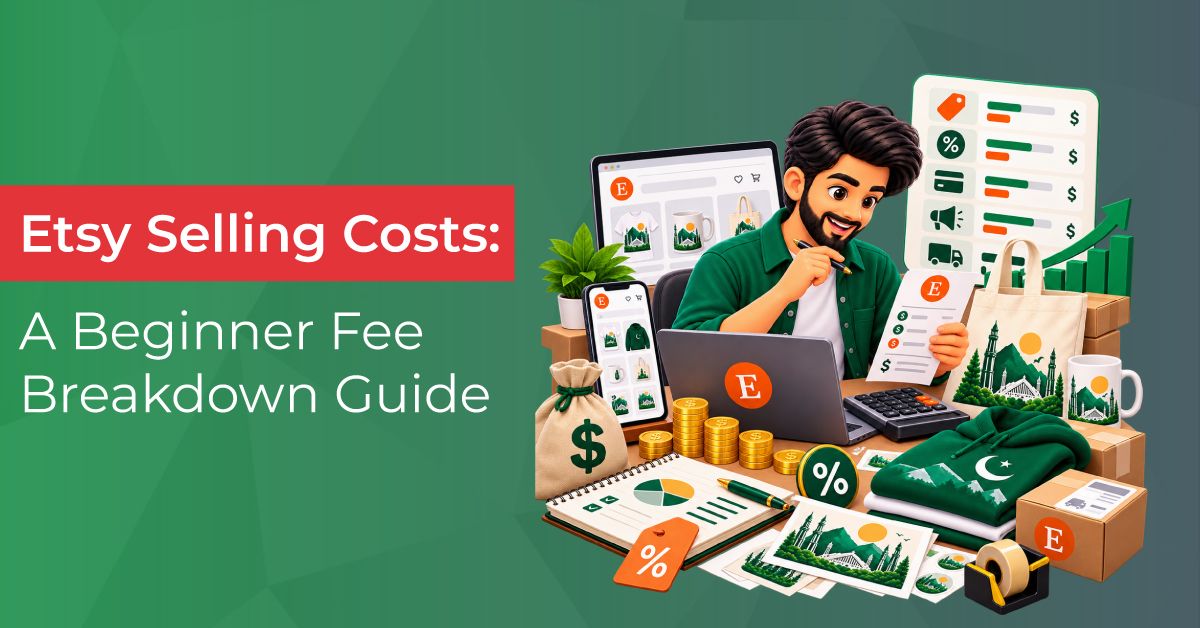
Let me be straight with you — Etsy is not free. And that's absolutely fine, because the marketplace they give you access to is worth every cent. But here's where new sellers go wrong: they see a product selling for $25, they make the sale, and then they look at their payout and wonder where half the money went.
I've seen this happen over and over again. A seller prices a handmade item at $20 thinking they'll pocket most of it, only to realize that between Etsy's cut, payment processing, shipping, and currency conversion, their actual profit is barely a few dollars. That's not Etsy being sneaky — that's sellers not doing their homework before listing.
This guide is your homework. By the time you finish reading, you'll know every single fee Etsy charges, how to calculate your real take-home profit, and how to price your products so you never end up working for pennies. Whether you're in Pakistan, the US, or anywhere else — these numbers are the foundation of a profitable Etsy business.
How Much Does It Cost to Sell on Etsy?
Etsy's fee structure isn't complicated once you break it down into categories. Most sellers deal with four main types of costs: listing fees (paid when you publish a product), transaction fees (taken from each sale), payment processing fees (for Etsy Payments), and optional advertising costs if you run ads.
Here's the quick-reference table every new seller should bookmark:
| Etsy Fee | When You Pay | Cost |
|---|---|---|
| 📋 Listing Fee | When publishing a product | $0.20 per listing |
| 🛒 Transaction Fee | After each sale | 6.5% of order total |
| 💳 Payment Processing Fee | When payment is processed | Varies by country (e.g., 3% + $0.25 in US) |
| 📢 Etsy Ads (Onsite) | Pay-per-click, if running ads | Budget you set |
| 🌍 Offsite Ads | Only when sale results from offsite ad | 15% (12% for high-volume sellers) |
| 🔄 Listing Renewal | After sale or after 4 months | $0.20 per renewal |
Complete Breakdown of Etsy Seller Fees
Etsy Listing Fee: $0.20 Per Product
Every time you publish a listing on Etsy, you pay $0.20. This applies to your very first product and every new listing after that. The listing stays active for four months — after that, if the product hasn't sold, Etsy automatically renews it for another $0.20. If you're listing 50 products, that's $10 upfront before you've made a single sale.
Here's a detail many people miss: if you list a product with a quantity of 5 and sell all 5, Etsy charges a $0.20 renewal fee for each unit sold. So you pay once to list, then $0.20 each time a unit is sold and the listing renews. For products you sell regularly in bulk, this adds up.
Etsy Transaction Fee: 6.5% Per Sale
This is Etsy's main revenue from your shop. Every time a buyer completes a purchase, Etsy takes 6.5% of the total order value — and "total order value" includes the item price AND the shipping cost you charged. That last part catches a lot of sellers off guard.
If you sell a $30 item and charge $5 shipping, Etsy's transaction fee applies to the full $35. That's $2.28 just from this one fee. Multiply that by hundreds of orders and you understand why knowing this number matters so much.
Etsy Payment Processing Fees Explained
If buyers pay through Etsy Payments (the platform's built-in checkout), you'll be charged a payment processing fee. This varies by your country:
| Country | Processing Fee | Fixed Fee |
|---|---|---|
| 🇺🇸 United States | 3% | + $0.25 |
| 🇬🇧 United Kingdom | 4% | + £0.20 |
| 🇨🇦 Canada | 3% | + CA$0.25 |
| 🇦🇺 Australia | 3% | + AU$0.25 |
| 🇪🇺 EU Countries | 4% | + €0.30 |
| 🌍 Other countries | 4–6.5% | Varies |
Since most Pakistani sellers receive payments through Payoneer and operate under a different billing country setup, the processing fee rate that applies to your transactions depends on how your account is registered. This is something to verify directly in your Etsy payment settings.
Etsy Ads and Offsite Ads Fees
Etsy has two types of advertising you should know about — and they work very differently.
Onsite Ads (Etsy Ads): These are optional. You set a daily budget, and Etsy promotes your listings within the Etsy platform itself (search results, category pages). You pay per click — regardless of whether that click converts into a sale. If you set a $5/day budget, you could spend that on clicks with zero sales. Ads only work if your listings convert — here's how to optimize your Etsy titles, tags and photos first.
Offsite Ads: This one is not always optional. Etsy promotes some listings externally on Google Shopping, Facebook, Instagram, Pinterest, and Bing. If a buyer clicks one of those external ads and purchases from you within 30 days, Etsy charges you 15% of the order total. If your shop made over $10,000 in the past 365 days, this becomes mandatory at 12%.
Hidden Etsy Costs Beginners Often Miss
The fees I've listed above are Etsy's official charges. But experienced sellers know there are additional costs that eat into your profits — costs that don't show up on any Etsy fee page but are absolutely real.
Currency Conversion Charges
If your Etsy shop sells in USD but your bank or payment provider operates in a different currency (like PKR for Pakistani sellers), currency conversion fees apply. Payoneer, the most common payment platform for Pakistani sellers , typically charges around 2–2.5% for currency conversion when you withdraw USD to a local bank account in PKR.
On a $30 sale, that's up to $0.75 lost just in conversion. Over hundreds of sales, this becomes a significant number that most beginners never account for when they calculate their expected profits.
Shipping and Packaging Costs
Many new sellers — especially those selling digital products — don't deal with physical shipping. But for physical product sellers, this is often the most significant cost after Etsy's own fees. You have to factor in:
- Actual postage or courier cost (DHL, FedEx, local postal service)
- Packaging materials: boxes, bubble wrap, tissue paper, tape
- Branded packaging: custom boxes, stickers, thank-you cards
- Insurance for high-value shipments
- Time spent packaging (if you're calculating your own hourly rate)
Shipping from Pakistan to the US typically costs $15–40 via DHL depending on weight. If you're charging your buyer $5 for shipping and the actual cost is $20, you're subsidizing $15 from your product margin. This calculation absolutely must be done before you set any price.
Listing Renewal and Additional Quantity Fees
Every 4 months, inactive listings automatically renew for $0.20. If you have 100 listings that haven't sold, you're paying $20 every 4 months just to keep them live. Additionally, every unit sold from a multi-quantity listing triggers a $0.20 renewal. These small amounts compound quickly in a busy shop.
Real Etsy Fee Example: How Much Do You Keep From a Sale?
How much do you actually keep from a $30 Etsy sale?
On a $30 product with $5 shipping (total order: $35), a seller in the US keeps approximately $28–29 before material costs after paying Etsy's listing fee, 6.5% transaction fee, and ~3.25% payment processing. Net profit depends on the cost of goods sold (COGS) — if the item costs $10 to make and ship, actual profit is roughly $18–19.
Let's walk through a real example with a handmade item priced at $30 plus $5 shipping:
| Sale Details | Amount |
|---|---|
| 📦 Product Price | $30.00 |
| 🚚 Shipping Charged to Buyer | $5.00 |
| Total Order Value | $35.00 |
| ➖ Listing Fee (per unit sold) | - $0.20 |
| ➖ Transaction Fee (6.5% × $35) | - $2.28 |
| ➖ Payment Processing (3% + $0.25 of $35) | - $1.30 |
| ➖ Actual Shipping Cost (e.g., domestic) | - $5.00 |
| ➖ Cost of Materials / Product Cost | - $8.00 |
| ✅ Estimated Net Profit | ~$18.22 |
How to Calculate Etsy Profit After Fees
The most important habit you can develop as an Etsy seller is calculating profit before you set a price — not after. Here's the formula every seller should use:
Let's put this into a simple calculation. Suppose you sell a digital planner for $15:
| Item | Calculation | Amount |
|---|---|---|
| Sale Price | — | $15.00 |
| Listing Fee | Fixed | - $0.20 |
| Transaction Fee | 6.5% × $15 | - $0.98 |
| Payment Processing | 3% + $0.25 | - $0.70 |
| Product Cost (digital = $0) | — | $0.00 |
| Net Profit | — | $13.12 |
Etsy Fees for Pakistani Sellers
If you're selling on Etsy from Pakistan, your fee situation has a few additional layers that local sellers in the US or UK don't face. Understanding these is the difference between guessing at your profits and actually knowing them.
Pakistani sellers receive Etsy payouts through Payoneer since Etsy Payments isn't directly available for Pakistani bank accounts. Payoneer charges a currency conversion fee of around 2–2.5% when withdrawing to a local PKR account.
Etsy charges all fees in USD. Your listing fees, transaction fees, and payment processing are all deducted in dollars — so if USD strengthens against PKR, your effective profit in rupees increases (and vice versa).
Every withdrawal from Payoneer to your Pakistani bank involves a conversion. At current rates (roughly 278–285 PKR per USD), your $20 net profit becomes approximately PKR 5,600–5,700. Include this step in every profit calculation.
International shipping adds a major cost layer for physical product sellers. DHL from Pakistan to the US starts at $15–20 for small packages and can reach $35–50 for larger ones. Digital products completely avoid this problem.
Revenue earned through Etsy is taxable income in Pakistan. If you're registered with PSEB (Pakistan Software Export Board) or operating as a freelancer, document your earnings and consult an accountant about FBR obligations.
Since you're pricing in USD, always calculate backward from your target PKR income. If you want PKR 10,000 profit from a sale, that's roughly $35 USD at current rates — then add Etsy's fees on top to set your final listing price.
How to Price Etsy Products After Including Fees
Pricing for profit on Etsy isn't about picking a number that sounds good — it's a calculation that starts with what you want to earn and works backward to the price you need to charge. Here's the step-by-step approach experienced sellers use:
Decide how much you want to actually keep from each sale. This is your floor — everything else builds on top of it. For example: "I want to make $15 on this item."
What does it cost you to make, source, or create this product? Include materials, printing, packaging, and your time at a reasonable hourly rate. Add this to your target profit.
What does it really cost to ship the item? Don't guess — get an actual quote. Add packaging material costs here too. If you're offering "free shipping," this cost comes from your product price.
To work backward through Etsy's ~10–13% total fee, divide your required total by 0.87 (or 0.87–0.90 depending on your payment processing rate). This gives you the minimum listing price to hit your profit target.
Search Etsy for similar products. Is your calculated price competitive? If it's significantly higher than similar listings, you need to reduce costs, not undercut your profit. If it's lower, you may have room to increase.
Free tools like Etsy Fee Calculator (available as browser extensions and online tools) let you input your price and see the exact breakdown instantly. Use these to check every single listing before publishing.
Common Etsy Fee Mistakes New Sellers Make
After watching countless new sellers stumble through their first few months, the patterns are pretty clear. Here are the mistakes that cost sellers the most money — and how to avoid them from day one.
Ignoring Hidden Fees
New sellers look at the 6.5% transaction fee, add it to the $0.20 listing fee, and call it done. They forget payment processing, currency conversion, Payoneer fees, packaging costs, and listing renewals. By the time all hidden costs are counted, effective fees are often 13–18% of revenue.
Underpricing Products
Beginners often price low to attract buyers. But if you're pricing at $10 when the fees and costs require $12 to break even, you're actively losing money on every sale. Etsy buyers pay for quality and uniqueness — don't race to the bottom on price when your product deserves better.
Forgetting Shipping Costs
Offering free shipping is a good conversion strategy, but it's never actually free — you're just building it into your product price. Sellers who list items with free shipping without factoring the actual postage cost into their price end up paying for shipping out of their profit margin.
Not Calculating Profit Before Listing
Many beginners pick a price based on what "seems right" or what competitors charge, then check their profit after sales start coming in. This is backward. Calculate your minimum viable price before publishing any listing — once you have reviews and sales, changing your price becomes much harder.
Frequently Asked Questions About Etsy Seller Fees
Know the Numbers Before You List
Here's the honest truth that most Etsy guides won't tell you: the sellers who struggle on Etsy aren't struggling because of bad products. They're struggling because of bad math. They priced based on what felt fair, not what the numbers actually required — and by the time they realized their margins were thin or negative, they'd already built a shop full of underpriced listings with reviews they didn't want to mess with.
Don't be that seller. The fee structure I've broken down in this guide is simple once you understand it. Take 10 minutes before your first listing, open a spreadsheet, and run the numbers. Then price accordingly. Etsy gives you access to millions of buyers — that's worth the fees. But only if you've done your homework first.
For Pakistani sellers, add one extra step to that homework: calculate your PKR take-home after Payoneer conversion. Your pricing strategy should be built around your real income goals, not just the dollar amount on your Etsy dashboard.